
THIS POST MAY CONTAIN AFFILIATE LINKS. PLEASE SEE MY DISCLOSURES FOR MORE INFORMATION

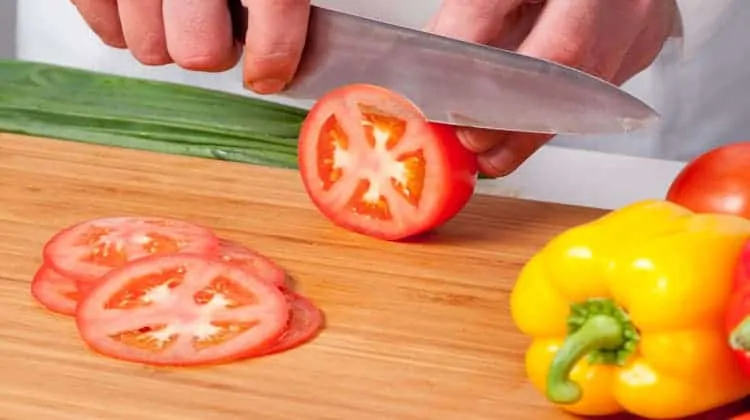
When you want to make a meal, are you clueless when it comes to what kitchen knives to use? Do you just randomly pick one and hope for the best?
If you want the best kitchen knives and walk through a store to look at the large selection, chances are you will get overwhelmed.
Do you buy knife block sets or individual knives? Are German or Japanese knives better? What about steel or ceramic?
If you think about how much time you spend in the kitchen, you will quickly realize that your most used tool in your entire arsenal is your kitchen knife. As such, spending some time and money to choose the right kitchen knives is going to make a world of difference.
In this post, we are going to walk through the world of knives so you understand the importance of buying the best kitchen knives.
And don’t think you need to spend a fortune on kitchen knives. We’ll even show you the best kitchen knives you can buy for $200 and under!
Table of Contents
How To Choose The Best Kitchen Knives
Skip The Cutlery Holder
Let’s start off the discussion with the one thing you don’t need. The cutlery holder or knife block. The knife block is a travesty found in millions of kitchens. The money spent on a cutlery holder would be better spent on one or two quality knives.
Just what is my gripe against knife blocks? First is the block itself. It turns out it is very unhygienic. If you put a knife that isn’t completely dry in the block, the moisture has no way of draining out. This can lead to bacterial growth or even mold and mildew.
The next problem is the wasted space. Having extra stuff on your counter just ruins the overall look of the kitchen. You can easily keep your knives in a drawer and have their sheath on to protect the blades and your fingers.
The third problem is that you just don’t need all those knives. Take a look at the knife sets sold at your local discount store or local kitchenware store. There are probably about half a dozen knives, not counting steak knives.
I received a cutlery holder as a wedding present and it contained the following:
- chef’s knife
- carving knife
- bread knife
- sushi knife
- cheese knife
- filet knife
- paring knife
- kitchen shears
I don’t even like sushi, let alone make it! Likewise, I don’t buy whole fish, so I do not need a filet knife.
Out of that entire list, I regularly use the chef’s knife, the paring knife, and the shears. The carving knife has been used once in three years and the bread knife a handful of times. The cheese knife has never actually seen cheese.
Consider for a moment that those knife sets start at about $20 for absolute no-name, cheap stuff that wears out in a couple of years to $200 for a big name brand such as Wusthof.
For that money, I could have gotten myself a quality chef’s knife that meets my preferences better than this one, a good paring knife, and a pair of kitchen shears from the dollar store because really, there is no difference between them and the $20 pair at Bed, Bath, & Beyond.
Now that you see buying these sets are a waste of money, let’s get down to business and see the best kitchen knives that you will actually use.
What To Look For In A Chef’s Knife
A chef’s knife is the backbone of your kitchen. You can use it for just about everything. It will be the single most expensive utensil in your kitchen. And having the right one will be the difference between it being a chore and a delight to use.
Always get a knife that has a full tang. The tang is the metal part of the knife that sticks past the blade and into the handle. Having a full tang will increase the durability of the knife.
I once owned a part-tang chef’s knife and actually had the handle break off in my hand. I escaped free from serious injury, but the incident made me hesitant for the next few weeks in the kitchen.
Luckily, part-tang knives have really gone out of style these days and even the cheaper knives have a full tang. Even so, you should still verify any knife you are looking at is full tang.
Chef’s knives come in three basic sizes, 6, 8, and 10 inches. This is the length of the blade, measured from the heel to the point.
Which size works best is a matter of choice. Your best bet is to go to a housewares store and test different knives to find the size the fits you best.
The other fundamental decision you will need to make is the style. By this, I don’t mean the color of the handle or the material. I mean the great debate in knife manufacture: German vs Japanese.
Both have their advantages and drawbacks. Here is what makes each different.
German Knives
German blades are heavier. They use softer steel with a blunter edge to handle the brunt force of Western-style chopping. They require sharpening more often and are sharpened to about 40-50 degrees.
German knives are designed to be sharpened from both sides. They also have a well-defined belly, or curve, starting about halfway down the blade.
Japanese Knives
Japanese knives use harder steel and have a thinner edge. They are designed for more finesse and will go longer before needing to be re-sharpened. Typically, they are sharpened to 30 degrees or less. The blade is only sharpened from one side.
Japanese-style blades have less of a belly and usually have more of a diagonal line profile instead. These blades are lighter in weight, sometimes as little as 40% of the weight of a similarly sized German knife.
Choosing between a German or Japanese knife is a matter of preference. I like the heft of German knives, but I have the size and strength to put into it. If you are smaller, you may find Japanese knives to be more comfortable.
Again, spend some time testing the knives to find the right choice for you.
If the store doesn’t let you handle the knives, then they aren’t going to have the quality of blades you are looking for.
If you buy a quality knife and take the proper care in cleaning and sharpening it, you will find yourself never needing to buy another knife again.
Best Kitchen Knives Under $200
Now that you know what you are looking for in a knife, let’s look at the best kitchen knives for every budget. Luckily there are some great knives for you, regardless of the size of your budget.
If budget is not an issue and you can spend well over $100 on a chef knife, here is our selection for the best kitchen knives under $200.
- Wusthof Classic 8-Inch Chef’s Knife: The Wusthof Classic Forged Chef Knife is a very versatile knife and can be used for slicing, mincing, and dicing all kinds of food. Each Wusthof chef knife is forged from one piece of specially tempered high carbon steel with a stain-resistant alloy. The handle features a triple-riveted design, is contoured with a comfortable grip and made of a highly durable polymer. The Wusthof Classic 8-Inch knife is made in Germany and comes with a lifetime guarantee. You can buy it on Amazon for $129.
- Dalstrong Chef’s Knife – Shogun Series: The Dalstrong Chef Knife is one of the best Japanese knives for its cutting-edge technology and stunning designs. It is perfect for cutting and slicing all types of ingredients in the kitchen. The knife is more effective with full-tang and razor-sharp hand polished blade. The Dalstrong comes with a lifetime guarantee. You can buy it on Amazon for $117.
- Zelite Infinity 8-inch Chef Knife: The Zelite Infinity Chef Knife 8-inch features 67 layers of high-carbon stainless steel, making it a long-lasting and high-performance knife. Its Damascus pattern design provides a great look. This chef knife is specifically better for chopping, slicing and dicing vegetables, fruits, fish, and meats. The Zelite Infinity chef knife comes with a lifetime guarantee. It can be bought on Amazon for $129.
Best Kitchen Knives Under $100
If you are looking for the perfect balance between quality and price, you can find great knives for under $100. Here is our selection:
- Sabatier Olivewood 8-Inch Chef’s Knife: The Sabatier Olivewood 8-inch Chef Knife features a high-carbon stainless steel blade. Its classic wood handle is a distinctive touch. The knife has and is perfectly weighted and balanced for control and ease of use. The Sabatier Olivewood 8-inch Chef Knife is made in France and comes with a lifetime guarantee. It can be bought at Amazon for $74.
- Misen Chef’s Knife: The Misen Chef Knife combines innovative design, premium material, and non-traditional direct-to-consumer pricing. The knife features forged steel with an above-average carbon content for longer-lasting sharpness. Its blade is curved, making it easier for rocking cuts. Its sloped bolster makes for a more comfortable grip. The Misen Chef Knife can be bought on Misen online store for $65.
Best Kitchen Knives Under $50
If you don’t want to spend more than $50 for a chef’s knife, you can still find some great options for well under $50.
- Damascus Kitchen Chef Knife: The Damascus Kitchen Chef Knife features a uniquely patterned steel containing up to 18% chrome, which will prevent the knife from fading or tarnishing even after using it for a long time. Its Pakka wood handle provides a classic and stylish appearance. The Damascus Kitchen Chef can be bought on Amazon for $59.
- Mercer Culinary Genesis 8-Inch Forged Chef’s Granton Edge Knife: The Mercer Culinary Genesis Chef Knife features hollowed indention’s, which prevent it from suctioning when cutting damp items. It’s made from extra-strong forged German steel with a taper-ground edge for extra stability. The handle is made of Santoprene, offering superior comfort and a non-slip grip. The Mercer Culinary Genesis 8-Inch Forged Chef Knife comes with a limited lifetime warranty. You can get it from Amazon for $50.
- Victorinox Fibrox Pro 8-Inch Chef’s Knife: The Victorinox Chef’s Knife features high carbon, stainless steel blade. It is hand finished by skilled craftsmen in Switzerland. A unique tempering process is used to produce an edge that can be re-sharpened countless times, making its blade extremely durable. The Victorinox Fibrox Pro 8-Inch Chef’s Knife is made in Switzerland, and you can get it from Amazon for $40.
Ceramic Kitchen Knives
Up until now, we have focused solely on metal kitchen knives. But many great chefs swear by ceramic kitchen knives. What’s the difference between metal and ceramic?
Ceramic kitchen knives offer several advantages over traditional metal knives. Ceramic knives are lighter, they will not oxidize, and they need minimal sharpening. Ceramic blades can cut meat, fruits, vegetables and there are even serrated ceramic knives to slice bread.
Another advantage is that ceramic kitchen knives eliminate the transfer of metal ions that can alter the taste and smell of fresh foods.
One drawback of ceramic knives is they should not be used for cutting frozen goods or bones, as they might chip doing so. They also have to be treated more gently than traditional steel knives, as they can break if handled roughly.
Best Ceramic Chef Knives
If the idea of ceramic kitchen knives interest you, here are the best kitchen knives, all of which are under $100.
- Kyocera Advanced Ceramic Revolution Series 8-inch Professional Chef’s Knife: The Kyocera Revolution Ceramic Chef Knives made of Kyocera proprietary advanced ceramic, Zircon 2016, offer a stronger, denser blade that holds an edge longer than other ceramic knives. This knife will never brown your food and never rust. The will maintain its edge up to 10 times longer than steel blades. This knife is ideal for slicing fruits, vegetables, and boneless meats. With a blade length of 8”, this knife weighs only 0.42 lbs. The Kyocera Advanced Ceramic Revolution Series Chef Knife can be bought on Amazon for $79.
- Cuisinart Elements Ceramic Open Stock Chef’s Knife: The Cuisinart Ceramic Knife features a sharper, stronger, more durable than stainless steel, break-resistant ceramic blade. The handle is ergonomically designed to provide excellent comfort and strength. The Cuisinart Ceramic Open Stock Chef Knife comes with a five year limited warranty. You can buy it on Amazon for $28.
- Jaccard Ceramic 8-Inch Chef’s Knife: The Jaccard’s Advanced Ceramic Chef Knife Ultra-pure ceramic composition prevents browning of fruits and vegetables. Its blade maintains its factory edge up to 15 times longer than stainless steel blades. The Jaccard Advanced Ceramic knife comes with sharpening for life guarantee if you need to sharpen the blade, send them to Jaccard, and they will do it for free (shipping not included). You can buy it from Amazon for $40.
Wrapping Up
At the end of the day, the kitchen knife is your most used tool when preparing meals.
As such, it makes sense for you to put in the time to find the perfect one for you. Remember to skip on the cutlery holder as they are overpriced and offer many knives you will rarely, if ever, use.
Instead, spend your money on the best kitchen knives that you can afford and fit into your routine. For most people, these means spending money on a chef knife. By buying the best kitchen knives, you will save yourself a lot of time and enjoy cooking even more. And the best knives will last a lifetime.
